Central Asia
The Silk Road
Fell Walking in England
The name “Silk Road” conjures images of camel caravans transporting bolts of silk, precious metals, and finely crafted objects from east to west and back again - from China, Rome, Istanbul, and Venice. Traders braved the barren deserts, treacherous mountain passes, and savage raiders to bring their wares to markets around Central Asia, which was the pinch point on the east/west passage.

Names like Taklamakan, Tashkent, Samarkand, Khiva, Amu Darya, and Bukhara stir the hearts of us history buffs as we imagine the bustling bazaars and dusty caravanserai of a bygone era, and larger than life figures such as Alexander the Great, Marco Polo, Genghis Kahn, and Tamerlane who changed the fates and fortunes of Central Asian cities and tribal communities.
Today these countries form a region that is defined by modern cities, agricultural zones, and traditional lifestyles - still showing traces of the recent past as part of the Soviet Union.


Background
The phenomenon that is today known as the Silk Road in Central Asia goes back 2,500 years to the very earliest settlements made prosperous by the exchange of valuable items moving east and west on the Asian continent. The human lust for beauty and material goods spurred the development of trade routes and enriched settlements that provided respite, safety, and marketplaces for traders. Rather than a stream of travelers roaming 5,000 miles between end points in China and Europe, the Silk Road was more like a chain of trade routes, with traders staying within their local environs where the terrain, oases, and dangers were well known, and passing on their goods to the next link in the chain.
The flow across the continent included not only goods, but also ideas, religions, technologies, and innovations - evolving the cultures and traditions of the area. Over the centuries, the ethnic and cultural makeup of these lands changed many times, with invaders from east and west replacing peoples and their architecture as empires expanded and collapsed.
Central Asia today, also known in the west as “The Stans,” consists of what are now countries with borders that were created for political expediency, rather than any effort to retain cultural identity. These countries include Kyrgyzstan, Kazakhstan, Uzbekistan, Tajikistan, and Turkmenistan. The ethnic backgrounds of the people in these countries are Mongolian, Caucasian, Turkic, Persian, and Russian, and many languages are spoken in these lands. Even the written alphabets changed over time from Latin, to Arabic, to Cyrillic, and now trending back to Latin.
How to book:
-
Central Asia does have a tourist trade, although one can say that the region has not yet been fully “discovered.” I wanted to go before it becomes overcrowded with tourist buses. I met people from all over the world seeking the same romance that drew me there, the Silk Road. If you go, it is best to be prepared for what awaits you.
-
Booking with a tour company will provide you with the benefit of local guides speaking local languages, reliable transportation (the concept of "road" is different here), and quality lodging. If you take this option, try to find a company that will get you face to face with local people so you can see how they live and converse with them through the translator - otherwise you are only visiting tourist sites and you won't get a true flavor of this exotic and fascinating part of the world.
Weather
-
Some of these countries are mostly mountainous and some are mostly desert. During the 3 weeks I spent touring the 5 “Stans,” the weather ranged from wet and chilly in Kyrgyzstan and Kazakhstan to scorching hot in the Karakum desert in Turkmenistan.
-
The spring and fall are the best times to go, when it is not too cold in the mountains and not death-defyingly hot in the deserts.
Currency
-
Each of the 5 countries has its own currency, but credit cards are accepted at many establishments, especially in the cities, and almost all will accept the American dollar (with a less than favorable exchange rate).
-
It is best to bring with you dollars in small bills, and to plan to either change money at the border of each country or use ATMs in the more populated areas to get local currency. At the bazaars you will probably be asked to pay with cash rather than credit, and in the small towns and villages money is essential for purchasing things.
Language
-
Each of the 5 “Stans” has it own language, although some are similar to each other as well as to neighboring big brothers such as Turkey and Iran, but all have populations that speak several languages. The ebb and flow of different invading cultures over the millennia have created a melting pot of cultural traditions, not conforming to political boundaries.
-
As these countries were part of the Soviet Union for 70 years, Russian is often spoken as a second or third language and Cyrillic is still used on signage. Memorizing the Cyrillic alphabet before you go will enable you to read road signs and market labels - I highly recommend doing this. It took me only a couple of weeks to get it down with daily flash cards. I also tried to learn Russian, which is really only useful for a small handful of phrases. You will learn the local sayings, such as please and thank you and toilet, pretty quickly once you are there.
Transportation
-
Although the major cities are quite modern, clean, and beautiful, and the streets there are smooth and drivable, the “roads” in the long stretches of countryside between cities are abominable. Many are not paved, but even those that were once paved are now more reminiscent of the cratered surface of the moon.
-
You may want to fly between cities rather than trying to drive long distances. The airports and airlines are modern and pleasant.
-
Plan to be dusty, dirty, and sweaty most of the time.
Borders
- The border crossings can take a long time. Partially this is due to the Central Asian love of bureaucratic administrative processes, and partially due to the pushing, shoving, and line cutting behaviors of the locals.
-
Entering the country of Turkmenistan will require: a customs payment, a COVID test payment, and an entrance fee. These amounted to USD$97 when I was there in April/May 2025.
Cell service
- All the “Stans” have good cell coverage, except for Turkmenistan where you will find tight control over internet access. No cell service there and general communication blockage.
-
You can expect Wifi at all decent hotels
Bazaars
-
The bazaar is the heart of the community and you will find one in every town. I was told that you can tell the soul of the place by its bazaar. Not sure what that means, but each one we visited was unique.
-
You will find basic food stuffs, all the specialty dishes of each area, household goods and fabrics, as well as crafts and even tourist souvenirs. The larger bazaars have food production taking place, such as bread making. Bread is ubiquitous in Central Asia and each town has its own unique style. Some are high art!
-
The bazaar in ancient times was the place where not only goods were traded but also important information about daily goings-on.
Safety
-
When traveling around Central Asia, at no time did I feel unsafe. The people are exceptionally kind and friendly. The cities are modern and clean (I believe that every citizen owns a broom - even children can be seen sweeping streets in some places) and hospitable, with many of the conveniences we take for granted in the west (but not always!).
-
I did meet visitors who were traveling on their own, but going with a tour that provides guides with knowledge of local sites, regulations, customs, and languages is a bonus.
Customs
-
These countries are all islamic and some are very traditional. Many women are "covered" which is a custom that westerners might find objectionable, but it is necessary to be respectful of how these people live.
-
Mosques and mausoleums, even ones that are tourist destinations, require appropriate clothing. Women must cover knees, heads, and shoulders. Bring extra scarves for this purpose. Men must cover shoulders and knees - shorts are not allowed. Some venues will provide you with temporary coverings if you forgot to bring your own.
-
Many people in these lands will not let you take their photo. If you must, be clandestine about doing so.
Food
-
Central Asia is the land of meat and wheat. Meat includes lamb, beef, and horse and is included in pretty much every dish on the menu, including most salads!
-
Bread is also omnipresent. Each region has it's own specialty, but rest assured you will be provided with bread at every meal.
-
Some regional specialties are plov (pilaf, rice with meat), laghman (a noodle dish with meat), shashlik (kebabs), samsa (pastries filled with meat), etc.
-
You will be hard pressed to find vegetarian delicacies, although salad and lentil soup are almost always available. As a vegetarian, I was overall not impressed but the crispy fried eggplant dish is fabulous and I enjoyed it in most of the places we visited.

To help you make decisions about your trip
Travel Tips


Kyrgyzstan
The smaller of the two eastern Stans, this country is 80% mountainous terrain. Much of the water that falls on these mountains flows toward the other Stans and a small bit of it eventually into what is left of the Aral Sea. With such abundant water comes the benefit of hydroelectric power. Some of this power, in addition to water, is exported to neighboring countries.
The population consists of 40 semi-nomadic tribes of Mongolian heritage. There is rich arable land and agriculture is a large industry, but as in Silk Road times, the mainstay of the economy is trade. Thanks to relationships and a long border with China, Kyrgyzstan purchases goods from their eastern neighbor and sells to other central and western Asian countries.


Around Bishkek

Changing of the Guard

Horse Culture

At the Bazaar


Archaeology

Issyk Kul

The Yurt

Tien Shan Mountains
Kazakhstan


Kazakhstan is the largest of the “Stans” in geographic area. It is primarily steppe topography, with mountains to the north and south. The cities are far flung and travel between them is a major endeavor. In between there are nomadic communities.
This is the land of the yurt, the camel, and the horse. Horse culture goes way back, but made infamous by Genghis Kahn and the Mongol Horde. Horse trade with China was one of the initial factors in development of the Silk Road.
Kazakhstan is know for apples. Genetic forensics reveals that the apple originated in this region and the image is a symbol for modern Kazakhstan. The largest city, hard against the Kyrgyzstan border to the south, is Almaty - formerly Alma Ata which translates to "Father of Apples.”
A major facet of the economy in this country is oil and it funds modern and attractive public infrastructure. In Almaty there are museums, parks, and family entertainment worth a visit from tourists and locals alike.

Enterprising youth

The Kazakhstan Apple


Tajikistan

This country is 93% mountainous terrain - it is the home of the famous Pamir Knot, which is the meeting point from which spiral out several mountain ranges: the Himalayas, Karakoram, Hindu Kush, Kunlun, and the Tien Shan.


The capitol, Dushanbe, is a beautiful, modern, and clean city with great hotels, restaurants, museums, and lots of LED lighting at night!


Museum Artifacts


At the Bazaar


Access points into the mountain valleys are along conduits that can barely be considered “roads.” We travelled along some of these to reach Iskander (Alexander the Great) Lake and the Seven Lakes region in the Marguzor range. Unpaved, dusty, and bumpy, it takes quite a long time to travel a few kilometers, so folks rarely do.
The mountains are dotted with villages housing people who live simply, using donkeys for most local transportation and labor, and building their homes from the stones that are constantly being eroded off the still-growing peaks and tumbled down the steep slopes.
During our visit to one of these villages, a dump truck was transporting a very large pile of rocks into the village plaza for a family to build a new home. On our way north along a paved highway, we were delayed for a couple of hours while a landslide of rocks was being cleared from the road. You can almost hear the mountains growing higher!


Hisor Fortress

Uzbekistan
Some of the loveliest and best maintained remnants of the heyday of the Silk Road can be found in Uzbekistan. Although little remains of the earliest days, and artifacts from the Zoroastrian and Buddhist populations are found only in museums, the richness of the medieval Islamic architecture that proliferated during the Pax Mongolica sparkles at many restored locations in what were important Silk Road trading centers and are now UNESCO world heritage sites (the Pax Mongolica is the several hundred-year period of development when the trading routes ran like a well oiled machine, thanks to Genghis Kahn’s rules of the road).
Prominent in all the old Silk Road towns are the mosques, minarets, madrassas, and mausoleums dating from the 12th, 13th, and 14th centuries. Although generally not used for those original purposes, these fine buildings are museums and tourist attractions.

My favorite Uzbek town is Khiva, a small walled city that provides the visitor with a feel for what life might have been like during the height of Khiva’s importance as an oasis on the edge of the Karakum desert.


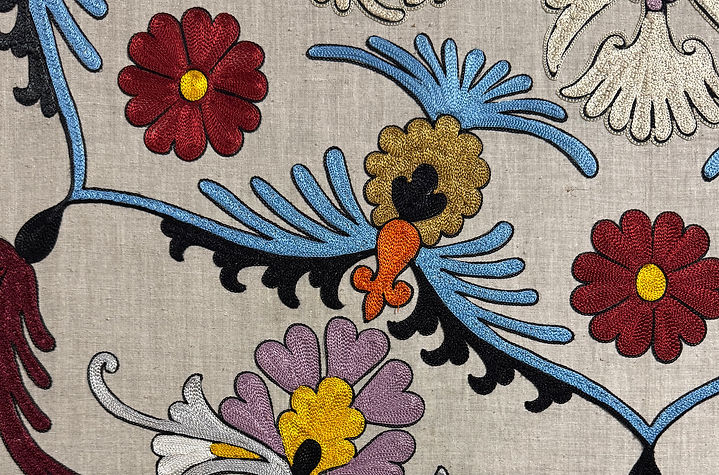
Silk is a major product, and visitors can find innumerable silk carpet shops and factories. Besides carpets, silk is widely used for clothing, scarves, and embroideries called suzanis.


Shakhrizabs


Sitori Mokhi Khosa Palace


Tashkent Metro


Ancient Artifacts

The Uzbeks are very good at commercializing any nook and cranny, and one will find vendors lurking in all the old glorious structures. Of particular fame is the Registan Square in Samarkand. This massive structure is an attraction at night with a lively light and sound show.


Motifs


Bukhara


Cotton is a mainstay of the economy and production of this crop blossomed during Soviet times, when the mighty Amu Darya river was siphoned off to provide irrigation for expanding cotton fields. Cotton is called “white gold” and is exported to many markets around the world. The cotton flower is a motif that appears in fabrics, tapestries, clothing, tile decorations, and even in the metro art in Tashkent (the capital city). I was told that cotton seeds were found in some archeological artifacts, so cotton has been a part of life here for a very long time.


The Once-Mighty Amu Darya

Hand Crafts


Food


Ulugh Beg's Observatory
Turkmenistan
Turkmenistan is a territory trying to be a country. It emerged in the 1990’s from communism with its dictatorship intact, and since then oil money has been sweetening the lives of the government elite, as well as providing an opulent but empty infrastructure in the capital city of Ashkhabad.
The “president” and his government have a very tight grip on the conveyance of information - consequently I was not able to receive data service for my cell phone, and internet access, particularly social media, is highly restricted.

Geographically, this country is a fringe of habitable areas wrapped round the Karakum desert. With 80% of the land a scorching barrenness, any promise of sustenance and protection from the sandstorms was serendipity in the Silk Road days.
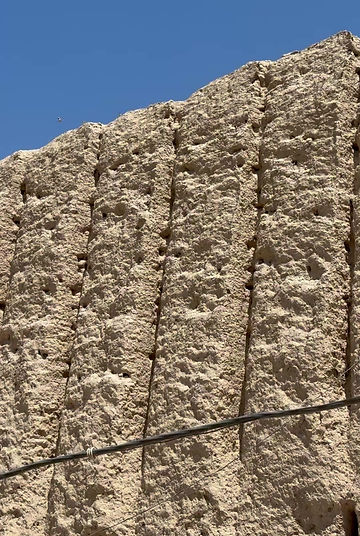
If you want to stand amongst the stones and dirt and feel what it must have been like to travel many miles through the desert in a caravan and come upon an oasis respite, you can find ancient ruins (that are more like mounds of clay bricks) at several archaeological sites around Turkmenistan. We visited Merv, Nisa, and Konya Urgench to walk around the dusty, baking hillocks with the legacies of once-thriving communities buried down below the surface (or locked behind glass in the museum).



The desert does have some redeeming qualities - smack in the middle of the Karakum lies the Darvaza Gas Crater, a major tourist attraction. There is a large amount of natural gas resource under the desert dust and this artificial crater was created during the Soviet era by geologists drilling into a cavern to access the gas. However the cavern collapsed, the engineers set the escaping gas on fire and thus it has been burning for over 50 years. Quite a spectacle at night. Tourists can spend the night within walking distance sleeping in a yurt and eating kebabs for dinner.


They love their horses
Ashkhabad is the famed White City. A destructive earthquake leveled the entire municipality in 1966 so what exists today has mostly been rebuilt since then, all in white marble. It is representative of purity and superiority. This city is worth visiting just to experience the grandiosity of the architecture. This preoccupation with white is also evident in all the automobiles on the streets. It is actually illegal to bring a car into the city that is not white, silver, or gray!