Switzerland
Did someone say Swiss chocolate? Cheese fondue? Swiss watches? Trains that run with the precision of Swiss watches? And jaw-dropping natural beauty?
Switzerland is a wealthy, famously “politically neutral” country where 9 million people speak four national languages, and nearly 70% of the land is mountainous. When fate hands you steep terrain, there’s really only one choice: conquer the heights. And the Swiss are master engineers. There is practically nowhere in this dramatic landscape of soaring peaks that hasn’t been made accessible by train, boat, funicular, gondola, cogwheel railway, or chairlift. If you can see it, you can get there.
Blanketed in snow during the winter, the mountains and valleys transform in summer. The warmth brings a vibrant green lushness to the meadows, where cows—adorably adorned with bells—spend long, happy days grazing on grasses mixed with herbs and wildflowers. And that brings us to the payoff: milk, butter, and cheese of extraordinary richness and flavor. Yeah...


Background
What springs to mind when someone says "Switzerland?" You may be thinking chocolate, Alpen snow-capped peaks, cows with bells, Swiss watches, or maybe political neutrality. Iconic images of the Matterhorn covered with snow, Heidi tending her flock of bell-laden cows, and Maria Trapp belting out "The Hills are Alive" while twirling through shockingly-green alpine meadows - these are ways we have romanticized Switzerland. It is all of those things and more.
Shaped somewhat like a short-legged octopus, it is a small country wedged between Austria, Germany, France, and Italy which is why there are 4 national languages - German, French, Italian, and Romansch (a romance language evolved from Latin, Celtic, and Raetic) - reflecting a long history of regional autonomy and cross-cultural exchange.
More mountainous than most European countries, the geography of Switzerland plays a central role in everyday life and shapes how people travel, work, and spend their leisure time. As we experienced on our two week train trip around the country, if you can see it, the Swiss engineers have built a way to get to it. Well-connected and amazingly precise transit networks make it possible to move between regions quickly. Boat ferries crisscross long, narrow glacier-formed lakes. Funiculars, cogwheel trams, gondolas, and ski lifts will take you up precipitously steep slopes to meadows, plateau villages, and craggy peaks.
Switzerland has a well-justified global reputation for precision and reliability, associated with industries such as watchmaking and engineering. It has built strong institutions and international relationships that support trade, research, and diplomacy. Life in Swiss cities like Zurich, Geneva, and Basel are a balance of thriving economies and international connections, with history and modernity coexisting side by side, while smaller communities in rural areas maintain lifestyles that are centuries old.
With such a wealth of natural beauty and resources, it is not surprising that the Swiss are highly focused on environmental sustainability: there are admonitions everywhere to separate your rubbish and keep the streets and landscapes clean; Swiss companies include their sustainability creds in their marketing material; there are legions of civic employees sweeping and tidying public places; and the azure-colored streams, lakes, and rivers are so clear and unsullied you can see down to the rocks (people swimming and floating along with the river currents is a common summer sight).
How to book:
-
This was one of the easiest bookings I did on my own. Everything you need for a well informed, efficient holiday is reliably available online. First research the things you should not miss (whether with hordes of other tourists or off the beaten path), then locate them on MyMaps (log into your google account), investigate transit opportunities for transfer between points and for access to some of the more far-flung places, and finally work out your itinerary and book your hotels and tickets online.
-
Get Your Guide or Trip Advisor will sell you tickets to the popular spots but research standard costs before you purchase.
Weather
-
Elevation above sea level varies from a few hundred feet at the Italian lakes to almost 15,000 feet at the highest Alpen peak near Zermatt. As expected, the higher elevations will experience colder temperatures winter and summer and more snowfall (sometimes forming glaciers). The lower elevations, particularly urban areas, can experience very warm and humid summers.
Elevation Map of Switzerland
-
Climate change is affecting weather predictions, so always check your weather app immediately before embarking on your journey and repack as necessary. It was consistently hovering in the upper 90's when we were in Bern, Lucern, and Zurich (July 2026).
Currency
-
Switzerland is not a member of the European Union and has its own currency, the Swiss Franc. Some of the tourist destinations and vendors will take Euros. Most transactions will be with credit. Be sure to carry small bills and coins for tipping.
Language
-
60% of Swiss citizens are German speaking so most of the signage, announcements on trains, and conversations with sales people will be in German. Many Swiss speak multiple languages as there are 4 official national languages. The Swiss are highly educated and English is taught in school, so you can get by with little knowledge of any of the national languages if English is your main tool.
Transportation
-
Riding the train system in Switzerland is not only efficient, it is delightful. We took several trains every day, and sometimes boats, and it was all covered by our Swiss Travel Passes. The pass also gets you 25 to 50% off the very expensive gondolas, funiculars, and cogwheel trains which you need to take to get up to the high country for the views (or skiing in winter). Link to Travel Pass website
-
Swiss lakes, formed by glacial action, are very log and narrow so to save having to drive around them, ferry boats ply the waters to transport people to towns along the shores. These ferries are included in the Travel Pass system.


To help you make decisions about your trip
Travel Tips


Glacier Express

Switzerland's Travel Centre has a few special train excursions for tourists, spotlighting the spectacular scenery in the alps. You can make a reservation on one of a variety of trip lengths and locales, and then hop on the train for a relaxing tour. International as well as native Swiss guests are treated to luxury in specialized train cars with lots of glass windows, fold-down tables between facing seats, and meals served by uniformed staff. We celebrated Cam's birthday on the rails between St. Moritz and Zermatt, a delightful 8 hour scenic voyage. When the dessert was served with a candle, the whole train car was singing "happy birthday!" Don't forget your camera!


Zermatt
This town with an international flavor at the end of a valley is famous for the excessive number of high Alpen peaks and fabulous snow - a skiing mecca. Even in summer it is like a magnet for tourists, who swarm through the quaint streets lined with authentic Swiss chalet buildings patronizing the chic boutiques offering designer goods with Alpen-high prices.
In the meadows above the town, visitors can avail themselves of jaw-dropping views of the surrounding peaks and the immensity of space between. Just a short funicular and gondola ride up the slopes.


Aletsch Arena
Glaciers move, tugged by gravity and almost imperceptibly, and the Aletsch, the largest glacier in the Alps, averages ~5" per day. Although you can't see it, down on the ice you can hear it groaning and squeaking. It is the convergence of 4 glaciers that flow off the highest peaks of the Bernese Alps, Jungfrau being perhaps the most well known.
By riding a series of gondolas, the visitor can summit the ridge forming the eastern boundary of the glacier and from there proceed on over craggy agglomerations of massive loose boulders, breathing the rarified air and feeling like mountaineers of olden days (and also maybe feeling a little bit of vertigo).


Ticino
In the Italian cantons, the elevation is lower and the days are warmer than in the rest of Switzerland. The architecture, language, food, and culture is characteristically Italian. One notices a change when transfering to a Ticino-serving train or bus - it feels like Italy.
The northern edge of Ticino butts up against some of the higher Alps and receives a great deal of the snow melt during warmer months. It also receives a great deal of the eroding rocks that are carried downstream by the rivers. These rocks end up as construction material in the homes that fill the small hamlets in the river valleys.
The Val Bavona, a literal a cul-de-sac, does not connect to the bustling cantons of Uri and Valais to the north - you must go around and through the mountain to get there. Consequently it's like a place out of time, where people have been living in stone houses for hundreds of years, unbothered by urban renewal. Yeah, some of them are now BnBs.

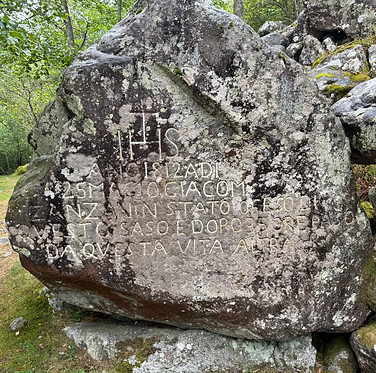

The Alps are crumbling! Don't worry, it's been happening for millions of years. At the end of these little valleys before the topography gets vertical, you can see evidence of rocks that were once the top of the mountain. These folks just go down to the riverbed when they want to build a new house!


Bern
The Aare river, in its serpentine path to the Rhine, created a perfect peninsula upon which to build a fortified town in the 12th century, and that old historic city center is today a UNESCO World Heritage site. It is famous for its fountains, clock towers, and building mounted statuary.
Like all the Swiss rivers we saw, the Aare is so clear and clean that in the heat of summer the residents of the city can be found floating along with the current on their inflatables or even without flotation aid - cooling off in the azure-colored, crisp, glacier-fed waters.


Lauterbrunnen
From the top of Schilthorn mountain, at the end of the Lauterbrunnen valley, one gets a spectacular view of the backside of the Bernese Alps, all lined up and dressed in glittering white. The well-known Bond movie, On Her Majesty's Secret Service, was filmed at this location in 1969. They even had to incite an avalanche to get the necessary action!
The Lauterbrunnen valley is famous for the multiple waterfalls that cascade off the surrounding cliffs, and for the grazing cows with their characteristic cowbells. By the way, you can purchase your very own cowbell at any of the many shopping outlets in this heavily touristed area.
We chose to catch a cogwheel up to the Kleine Sheidegg station and hike down the 2,600' vertical drop, an experience guaranteed to be awesome in scenic beauty and mostly free of the tourist hordes. Admittedly, we felt pretty trashed after that effort so took the bus to the Schilthorn gondolas.


Interlaken
Interlaken, the "place between the lakes", is a popular, active city known as an adventure sports hub and, in my opinion, a perfect frame for views of the Jungfrau massif. Situated between Lake Thun and Lake Brienz, and at the foot of the Bernese Alps, there is a plethora of actives to capture the interest of the young and the old, the adventuresome and the leisure-some alike.


They are serious about keeping the place clean


From atop Harder Mountain


Emmental Valley
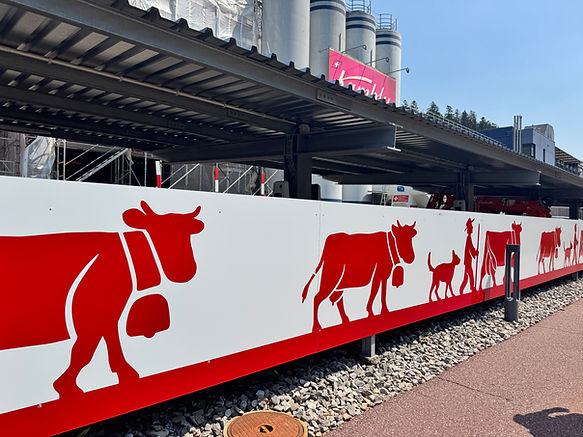
The Emme river flows through the Swiss lowlands, that is to say there are no snow covered craggy peaks in this area, just rolling hills with lovely green meadows. And, of course, cows. Drum roll: hence the world famous Emmental Cheese, of which the Bernese are very proud. There may be imposters made elsewhere, but the flavor is the proof in the pudding (as it were) of authentic Emmental cheese. Guests can visit the Emmental cheese factory and experience a very strange puppet, video, and light show, a walk through a model cheese making kitchen, and cheese sampling room - apparently touring the actual factory is not allowed. There is, of course, a gift shop where a wide variety of Swiss-made goods can be purchased, including Emmental cheese.
Also in the Emmental valley one can find the Kambly biscuit factory. On every hotel pillow and coffee cup saucer in Switzerland you will find a Kambly biscuit. We visited the factory where you can encounter the "Kambly experience" (a bunch of interpretative panels and props - they are proud of their sustainable practices which support local farmers), a huge shop with free samples of the hundreds of Kambly products for all to taste (you will feel pukey from all the carbs and sugar by the time you leave with your totebag full of purchases), and a cafe where you can rest after eating too many chocolate covered biscuits. But again, no factory tour.


At Langnau im Emmental there is a museum highlighting the history of the valley and the various occupations that were, over the years, housed in this 500 year old wooden building - cheese factory, pottery factory, wood cutting factory, linen fabric production, musical instruments, and a burger's home.


Lucerne
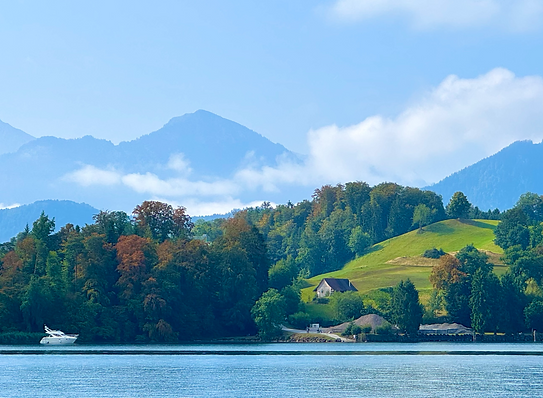
The city of Lucerne sits on a historic trade route just at the node where Lake Lucerne drains into the river Reuss. There are bridges. And boats. The lake, an odd forked shape, spreads out to the north and east, and the ferries that sail these waters will take locals and tourists alike to any number of locations on the shores. It is possible to sail on a ferry from Lucerne to a town across the lake, hike or gondola up a mountain, down the other side, and board a ferry at a different town and back to Lucerne. It's like a scavenger hunt!


Bell tower on the fortress wall in Old Town






Zurich Region
Up in the north where Switzerland is almost Germany and the Rhine river is young, lies the town of Stein am Rhein and the Rhein Falls, places of fascination for visitors.

Although the medieval walls of the town of Stein am Rhein are now converted to houses, the gate is still a narrow passageway that fits only one vehicle at a time (and they must be slim). Pedestrians have the run of the place and the visitor who has not been previously warned will have a nice surprise once in the town center - all the buildings are painted with murals. The townsfolk either had a lot of stories to tell or they got a smokin' deal on paint!


St. George is the patron saint of this town


I've been to many waterfalls, some claiming to be the highest, the widest, the greatest volume, the most visited, etc. but the Rhine Falls (in Swiss-German "Rhyfall," a singular noun) are said to be "the most powerful in Europe." Not sure what that means exactly, but the volume of water is impressive. There is a castle that sits atop the falls, with walkways that bring the visitor right down into the mist and roar of the "power" - a thrilling experience and welcome cooling in the midst of summer swelter.


Food


Switzerland's most famous foods, cheese fondue and chocolate


Quaffs
Zwickel Bier, Cam's favorite Summer cooler in Interlaken Toasting with local brews at the Foroglio falls


Prepared for Switzerland National Day. The rolls look like the Alps.


Available at the pastry shop. You can't leave without a bag full


Enjoying our morning cappuccinos at a sidewalk table
Cows and Sheep
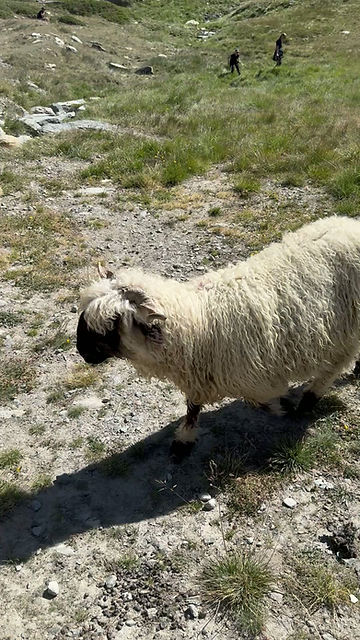
Switzerland's mountainous terrain, snowbound in winter and verdant green in summer, abundant with wildflowers and herbs, is too steep to be farmed but perfect for cows and sheep. For this reason, the area has been producing cheeses and dairy products since the neolithic age. Switzerland today crafts around 500 different kinds of cheese, and milk and butter figure highly in cuisine.
Hiking in the high country above the tree line one will find grass in the most unlikely nooks. Cam says, "wherever grass can grow, it will." And wherever grass grows the sheep will be there to eat it. They are natural acrobats.