
South Africa, Botswana, Zimbabwe, Zambia
Southern Africa
Mama Africa - there's a reason for this moniker, spoken with fondness and reverence. Over 100,000 years ago, Modern Humans wandered off the African continent and spread all over the globe. Coded within our DNA, we are all African. OK I admit it. I have a romanticized perspective regarding Africa. So I wanted to go see the place where we grew up. Oh, and "bag" some of those megafauna with my telephoto lens!


Background
Imagine walking down a street in your town, along with other residents and visitors, and suddenly a warthog is running along the gutter, monkeys are battling each other for the hamburger bun sticking out of the trash bin, and an elephant is knocking down the fence around a hotel to get at the fruit on the tree in the garden. Now you know what it's like in many towns in Africa.
If it happened to you every day, you too would think us North Americans silly for spending all this time and money to come to Africa to see this everyday occurance! Yet many places in Africa are thriving because of the traffic of tourists who want to "bag" their own Big 5 (meaning to get cool photos with those super-huge camera lenses).
The Big 5 are the five most dangerous species to hunt on foot, from the times when hunting African mega-fauna was a thing. These days, these animals are protected by seriously armed national park rangers! The Big 5, you may be surprised to discover, are rhinos, elephants, lions, leopards, and water buffaloes. Surprisingly, hippos are not on the list even though they are responsible for a great many human deaths every year. Also, giraffes are not on that list despite being the tallest freaking animals in the bush!
We went to southern Africa to see animals that you won't find in your backyard here in the states, including the African penguin which can only be found in South Africa, on land that is - they prefer the open waters and are quite clumsy on the beach where they nest (also in people's backyard, in car parks, under culverts, etc). They have their very own park in Simon's Town where humans can observe them from wooden walkways.
How to book:
-
Getting around in southern Africa can be difficult and sometimes dangerous. We booked three tours in different areas and connected them with flights.
-
There are many large tour companies based in countries outside Africa, such as Road Scholar, G Adventures, and Overseas Adventure Travel. These are reputable companies, but I recommend booking with a local tour company because you will get the benefit of a local guide who speaks the language and knows the potholes, and you will be supporting local African businesses directly.
-
We went to Cape Town and Simon's Town on our own and these are locations that are easy to navigate without guides.
Weather
-
South Africa is the country occupying the southernmost portion of the continent and the climate is similar to California. From the Western Cape you can almost see Antarctica if you squint (just kidding). The winter does get chilly and wet so prepare for an experience that may not fit your expectations about "Africa".
-
Botswana, Zimbabwe, and Zambia are considerably warmer and drier. The wet season, which is their summer, leaves the countryside green and moist with flowing rivers. In the winter, when there is no rain, the rivers trickle and many of the watering holes dry up. Those that are left are frequented by prey and predators so are easier to spot. This is the high season (June, July).
Currency
-
South Africa, Botswana, and Zambia have their own currencies that you can purchase at a Bureau de Change or extract from an ATM. USD is also accepted in larger communities. Zimbabwe's currency is so unstable that nobody uses it and you will see everything listed in USD.
-
Make sure to carry lots of small bills to leave as gratuity for the folks that support your enjoyable holiday (drivers, hotel housekeeping, restaurant waitstaff). They are much less fortunate that you and survive on a shockingly small monthly wage.
-
Many places will accept only credit cards since holding cash can be a liability. Even many of the roadside souvenir hawkers will accept your credit card.
Language
-
South Africa alone has 16 official languages, although English and Afrikaans are the most prevalent. Zimbabwe also speaks many tongues, with two of these the most widely used. You can get by with simple English in most places in southern Africa but having a guide is a great benefit.
Transportation
-
The roads in South Africa are quite good, where they are paved. Most of the roads in the national game parks are not paved and four-wheel drive is necessary. Safari vehicles are basic trucks that have been adapted to provide elevated seating with a roof but no sides, for unobstructed viewing.
-
Roads in Botswana and Zimbabwe are a mixed bag with some stretches of decent smooth surface, but many miles of potholes. The route from Chobe to Okavango in Botswana is "under construction" (written in May 2026) and should be avoided unless you like spending countless hours in the car.
-
Flying into national parks is the way many visitors manage the distances and avoid potentially questionable road surfaces, and there are small airports serving this tourist trade.
Entry Requirements
-
Visas are automatic in South Africa and Botswana, but Zimbabwe will extort you every time you cross the border, even if you are only going out of the country for the afternoon.
-
Vaccinations: Check with your health insurance provider several weeks before you leave home for vaccinations you may not already have. Malaria pills are recommended for the wet areas, even in the winter.
Safety
-
Crime in South Africa has become more prevalent lately. We were advised to stay in after dark. Johannesburg is a city with tall metal fences and security guards at every hotel and many restaurants. Our hotel would not let us walk around even during the day - they insisted that taxis are necessary to keep their patrons safe.
-
Although there is little crime in Botswana and Zimbabwe, there are actual wild beasts that roam around towns and villages in the dark.
Safari
-
Animals in national parks are not on a schedule for the convenience of visiting gawkers, so spotting the animal you wish to see is touch and go. The game drive guides know where certain species like to hang out and they all communicate with each other by radio. You might drive for an hour and see only impala and giraffe.
-
Morning and evening game drives are times when many animals come awake and active. It is cooler during these times so dress for a chilly drive in an open vehicle. Essentials for these drives: puffer jacket, neck gaiter, wooly beanie, binocs, telephoto lens, water bottle. Most drivers will have blankets to keep your legs warm on crisp mornings.

To help you make decisions about your trip
Travel Tips

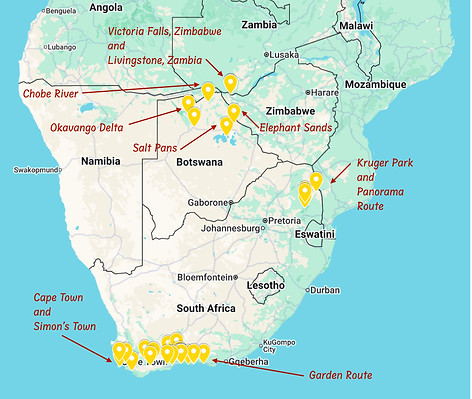
Cape Town
When the western world became sea-faring, the southern tip of Africa was a major stop along the way to the Indies, the land of spices and other riches.
The Dutch settled this part of Africa in 1652 and controlled farming and trade until the Boer wars when the British took over in 1806. The Dutch influence on language and culture is still very strong, with Afrikaans and English being the languages most spoken.
Cape Town, with it's generous harbor, was an important stop-over station, where ships would trade with the local clans for provisions. Now Cape Town is South Africa's hippest city with the most tourist appeal, a metropolis that extends all the way down to the Cape of Good Hope where the Indian and Atlantic oceans meet.

View from Table Mountain

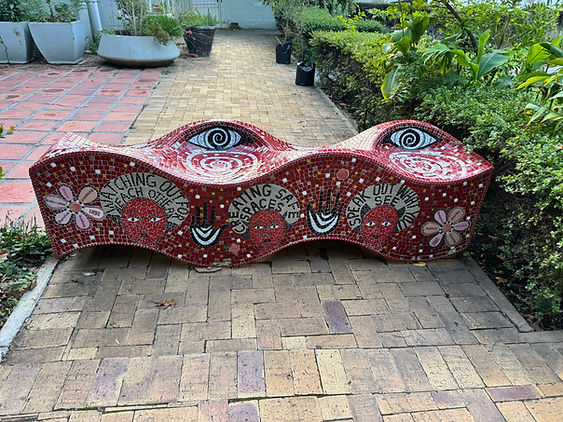
Table Mountain


V&A Waterfront


Simon's Town
I fell in love with the African Penguins who live in Simon's Town thanks to the Netflix 6-part voyeuristic show, "Penguin Town," in which penguins are serially personified while mating, breeding, and acting adorable and ridiculous. Simultaneously heartwarming and side-splitting, the story invites viewers to become honorary members of the endangered but slowly expanding colony of marine birds at this coastal community. So I had to go see for myself!

Simon's Town

Simon's Town

Penguin Town
I took 200 photos and videos of penguins. Here is a sample.

Penguin Town


Rock Hyrax (AKA Dassies)
Garden Route
Stretching along South Africa’s southern coastline, the Garden Route is one of the country’s most scenic regions - a landscape where emerald forests, rugged ocean cliffs, and rolling farmland meet the sea. Named for its green and garden-like nature, the area enjoys a mild, temperate climate at 34° south latitude, much like Southern California, with gentle winters, warm summers, and enough rainfall to keep the countryside lush year-round.
Beyond its scenic coastline, the Garden Route is a patchwork of fertile farmland and renowned wine estates, dotted with charming historic towns whose Dutch influences are still evident in their architecture and character. Along the shore, alluring sandy beaches alternate with dramatic outcrops of ancient rock, creating spectacular vistas that attract surfers, hikers, and whale watchers from around the world.
Exploring the region is a pleasure in itself. Well-maintained roads wind through forested mountains, farmlands, vineyards, and seaside villages, revealing a varied, changing landscape. Even nature occasionally reminds visitors that we are at the edge of the continent - during our visit, heavy rains washed out several river-crossing bridges, adding a touch of adventure (and many extra miles!) to the journey. Whether you're seeking outdoor activities (yes, bungee jumping is included in that category), wildlife encounters, fine wine, or photogenic scenery, a drive along the Garden Route offers a variety of experiences in one of South Africa’s most beautiful districts.
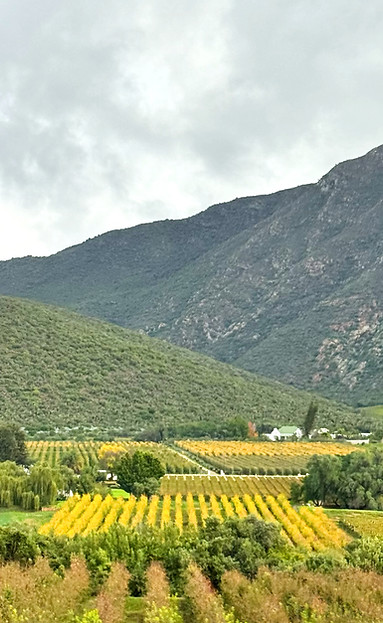
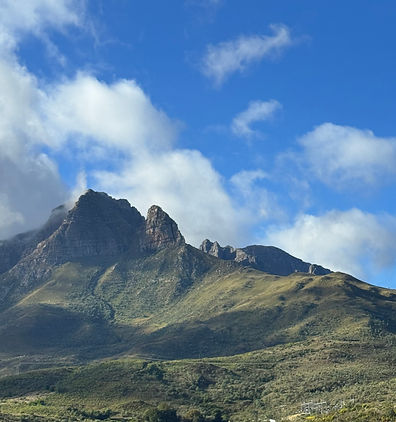

Dutch influenced architecture


Akkerboom Primary School

De Krans Winery, Calitzdorp

This Winery specializes in Pinotage, a hybrid of the Pinot Noir and Hermitage grapes, that grows only in South Africa and Australia.
Cango Caves, near Oudtshoorn

Monkeyland, Kirbywood


Ostrich Show Farm, near Oudtshoorn

The ostrich lays one egg every other day, until there are 11 to 18 in a nest.

Remember - their brain is smaller than their eye...

Birds of Eden, Kirbywood


Garden Route Game Reserve, near Albertinia


This preserve, which occupies almost 5,000 acres of previously farmed land, is home to a wide variety of large game species. They accept rescue animals from zoos and developments, and set them in this gorgeous landscape of rolling hills and scattered brush. The lions are kept in their own private park with a fence and gate between them and would-be prey. Although we did witness a cheetah dragging a fresh kill (young zebra)...


Kruger National Park
Back when humans were keen on shooting megafauna, the spectacular beasts that roamed the African continent were plentiful. Although the native wild brutes were greater in variety than you can count on both hands, the "Big 5" were the animals that became legendary for foiling the mighty hunters with guns. That moniker refers to the 5 most dangerous animals to hunt on foot (not the 5 that are most popular with tourists, as is often assumed). They are elephants, rhinos, leopards, lions, and buffalo.
These days, tourists flock by the millions to Africa to "bag" these game with their cameras, and the most harm that can come to these four-footed wonders is the embarrassment of being viewed in private moments by a horde of jeeps. Many of these extraordinary animals can be spotted whilst one is driving along the road in rural areas, but they are most bountiful in the national parks and protected private reserves. This is also the places where tourists are legion. Expect company on your game drive.
Kruger National Park, on South Africa's east side, is a protected natural woodland covering 7,576 square miles. It was established in 1926, South Africa's first national park, as a sanctuary for animals that were becoming endangered and rare. You can rent a tented room at one of several lodges inside the park and book one of their game drives, but, as the guides like to tell you, there is no guarantee that you will see any of the animals you long to capture on your camera. There are a lot of acres for the beasts to roam in and the jeeps must stay on the roads. And there are VERY many tourists competing for the same views.


The topography of Kruger is a varied landscape of mostly dense brush with some open savanah - eagle-eyed guides can spot an animal hiding in the shade.
Elephants seen in groups are a matriarchal clan. When a baby male elephant reaches a certain age, he is a threat to the younger females so he is booted and must wander alone seeking his own mate.
Termite mounds are ubiquitous. Although a complete census has not been conducted, estimates are about 4.6 million active and inactive mounds in Kruger Park. The mounds, built with termite spit and poop, are saturated with nutrients - farmers gather inactive mounds to fertilize their crops. The termites build the mound up at night. In the morning the rising sun dries the eastern side forcing the tip to point to the west. A compass for trackers.
The Lilac-breasted Roller is a gorgeous purple and aqua colored flyer, but elusive and hard to photograph.
Impalas are everyone's favorite lunch, so numerous are they. A herd of impala might number up to 40 - all female and young with a single dominant male guarding and "servicing" them.


African Wild Dog


Kudu


Our home-sweet-home tented lodge in Kruger Park
Panorama Route
After sitting in a jeep for hours bumping along dusty roads and craning your neck to see wild animals in the bush, it is enjoyable to take a break and breathe in fresh air amongst breathtaking South African scenery.
This is the Panorama Route, a stretch of scenic spots in the mountains and valleys just west of Kruger park on route R532. You will need to devote a full day for this exursion, which you can book through any safari company at Kruger. And bring your telephoto lens.

The Pinnacle

Timber plantations
God's Window

Bourke's Luck Potholes


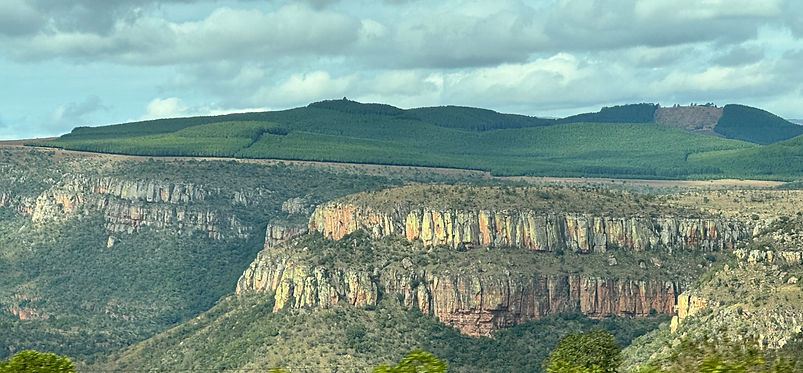


Blyde River Canyon


Chobe River National Park
It begins In Angola as the summer rains flow south and east, and gather as flood waters in low lying areas. One such area in Botswana, the Chobe river, which eventually becomes the Zambezi to the east, flushes the wetlands along the shores in the Chobe National Park and animals flock there when the dry season parches the land in Botswana.
Safari companies will take you on game drives along sandy "roads" in their specially outfitted pickup trucks with canopied tops, open sides, and graduated bench seats to maximize viewing. In Chobe there are many packs of lions that are accustomed to these gasoline-fueled behemoths skulking about and, despite the gaspingly close proximity of the teeth and claws of these cuddly felines to the humans inside the "jeep," they see these vehicles as neither prey nor predator - so no need to panic! Just sit still and don't put your arms outside the truck!
Telephoto lenses are always handy, but in Chobe it is possible to get close enough to the game animals that your iPhone Pro camera can do a pretty decent job of capturing the details in the fur and feathers. Of course, it is always serendipity when the animals cooperate and sometimes this just does not happen. We were very lucky in May 2026.


The acacia tree is the giraffe's favorite food. They have long eyelashes and rubber lips to protect their faces from the acacia thorns.
Vervet monkeys greet you at the picnic rest stops on safari and may even climb into your jeep to inspect your backpacks for food.
Baboons are often found in town scavenging, but their homes are in the bush.
Impala are lithe and quick with excellent eyesight. Why did Chevy name a lumbering hunk of metal after this beautiful animal?
Lions in the wild are active in the morning, as they are in the zoo - in the heat of the day they are napping.
Guinea fowl like to run on the sandy roads in front of your jeep. Our guide claimed that they are tasty (so, yeah, a favorite snack of predators).
Giraffe necks are so long that they must splay their legs in order to reach the grass underfoot.
Drinking water through the trunk is a learned technique, so baby elephants drink with their mouths until they develop the skill.
The elephant grows 7 sets of molars throughout it's lifespan. When the last set starts to wear down, they migrate to areas with "soft" food and eventually die there. These areas become "elephant graveyards."


Okavango Delta
Slipping soundlessly through a water world in a mokoro is the closest to nirvana I've ever come.
I sat low in the bow, below the water line, beneath the African sky, while the poler stood at the stern, guiding us through the channels of the Okavango Delta with effortless, noiseless sweeps.
The afternoon sunlight, melting like butter on our arms, glinted off the water in shades of gold and peacock blue. Tall reeds parted as we moved through them and lilies floated beside us like scattered stars.
There was no engine noise here, no roar of traffic or hum of machinery. The only sounds were the soft splash of the pole entering the water, the flapping of wings as the startled geese took off, and the rustle of reeds as the mokoro brushed against them. It was hypnotic!
As we drifted deeper into the delta, the landscape unfolded like a movie and I lost my usual spatial sense. Islands appeared out of the water, crowned with palms and acacia trees. A bull elephant waded in the shallow water, washing and munching on grasses. Our poler brought the mokoro to a halt, a reminder that the delta belonged not to visitors, but to the wild - it is not wise to cross an elephant in his watery habitat.
Time seemed meaningless. There was only the steady glide of the mokoro, the warm air and open sky above, and the feeling of moving through a completely untouched wilderness.
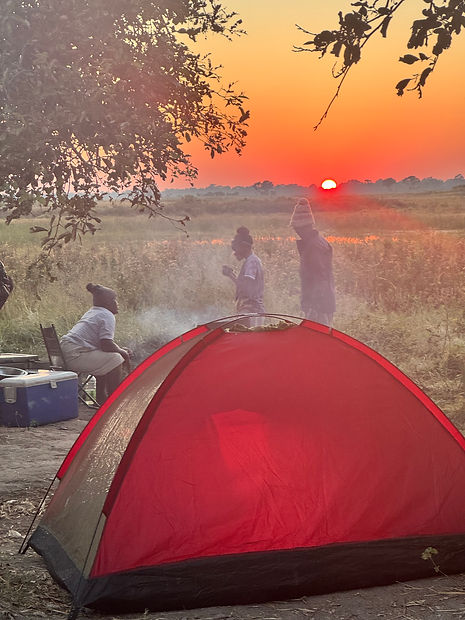
Finally as we reached our small island - our camping spot for the night - the delta stretched to every horizon, a mosaic of water and reeds, punctuated with clumps of trees. The boundaries between land and river are hidden from the casual observer - only skilled trackers and delta dwellers know how to place boots on solid ground. The smell of a wood fire and laughter from our camp friends beckoned as our mokoro was pulled out of the water for the night.




Impala footprints


Salt Pans
The Makgadikgadi salt pans is one of the largest salt flats in the world with a fascinating history.
Once upon a time, tens of thousands of years ago, this area was an enormous lake, which paleontologists call Lake Makgadikgadi, spreading over an area larger than some European countries.
Even further back, some 200,000 years ago, this region was the womb from which sprang Homo sapiens, as indicated by recent studies of human mitochondrial DNA.
Unlike then, when it was a vast, fertile area of lakes, rivers, and wetlands, it is now a savanah with large stretches of salt deposits. Nevertheless it is a grazing ground favored by wildebeestes, ostriches, flamingos, white pelicans, and other familiar Botswana species.


Elephant Sands
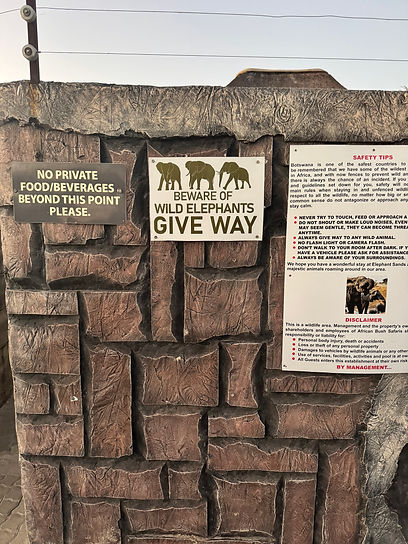
Private wildlife concessionaires provide the wild animals with something they need - a reliable watering hole - while providing visitors with something they need - up close and personal with the animals.
Although it's kind of a cutesy name, this lodge, perched on the lip of a large yearround watering hole, has comfortable tented accommodations, great meals, and guided game drives in addition to the valuable proximity to the wildlife doing their thing. Sometimes that proximity is a bit too personal - the proprietors warn visitors to NOT walk around in the dark.
Visiting the many maintained watering holes in the afternoon reveals interesting animal tracks and other spoor, and the slanting evening sun makes for great photos!



Shaking tree to harvest fruit

Making mud to spray on skin

Tearing off branch to get at leaves


Zimbabwe
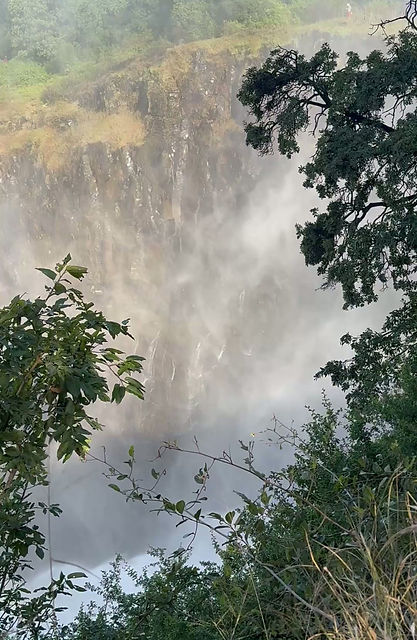
Called "Mosi-oa-Tunya" (Thundering Smoke) by local people, it was named Victoria Falls by David Livingstone in 1855 (remember Stanley and Livingstone, European explorers of Africa?). The Zambezi river, swollen with summer rains from Angola, floods the surrounding lands along the way in Namibia, Botswana, Zambia, and Zimbabwe before dumping a truly prodigious amount of water over the falls and into a very narrow channel, thus creating enormous back pressure forcing the spray back up in the form of "smoke."
Visitors are advised to bring raincoats (also for rent or sale at the visitor center) because that "smoke" comes tumbling back down doing a very convincing impression of a monsoon rainstorm.
Oh, and there is always a rainbow, for some an auspicious omen, making for excellent photo ops!


Photo Credit: Destination Livingstone Initiative

Kazungula Bridge
where 4 countries meet


In Victoria Falls town


Zambia
Right across the bridge over the Zambezi river from Victoria Falls town is the Zambia border. Commercial lorries and tourist vans make for constant traffic back and forth. Some of this commercial traffic is made on bicycle!
Fifteen minutes further brings you to Livingstone, with the usual amenities - notably ATMs that will actually dispense cash (unlike the ones in Zimbabwe).
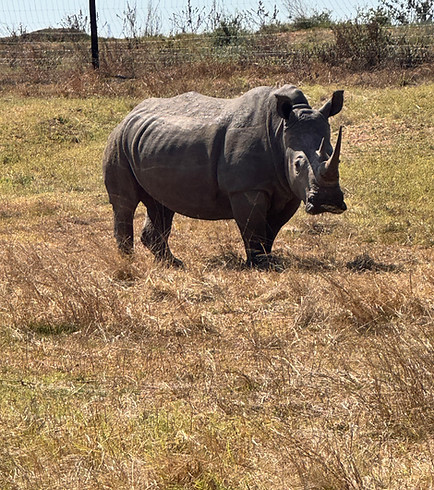
We braved this border crossing to see the Rhino Sanctuary. The government hires armed guards 24/7 to protect the herd of 10 endangered rhinos from poachers - a very serious threat.

Crossing the bridge


At best, elephants digest only 40% of what they consume, so they must forage up to 18 hours each day, roaming across vast areas dropping dung which provides food for other animals and seeds to broadly germinate plants essential to the ecosystem. This partly compensates for the trees that they tear down to get at the leaves...

Baboons roam freely in human settlements, scavenging (some would say cleaning up) human discards.

Though it may not seem like a smart move, one can get up close to these rhinos by moving slowly and stelthily (with the protection of armed guards at your back!). They have razor sharp hearing and sense of smell, but terrible eyesight and can mistake a human for a tree. So bathe well before approaching.
South Africa
Simon's Town Hotel
Lovely accommodations, excellent food, fantastic location, good price
Garden Route Hotels
Luxury accommodations, excellent food, ostrich farm
Excellent accommodations in safari setting with game drives
Garden Route Tour Company
Tour with high quality accommodations, good food, knowledgable guide, and varied and interesting activities
Kruger National Park
Camp inside park, tented accommodations, buffet meals, book game drives
We booked through Safari With Us agency
Botswana
Tour with choice wildlife sightings, good accommodations, good food, knowledgable guide
