
Galapagos
and Quito, Ecuador
Do the names "Darwin" and "Blue-Footed Boobies" bring to mind lava-strewn pacific islands teeming with odd and unique wildlife? Approximately 97% of the total land area of the Galápagos Islands is designated as the Galapagos National Park - a UNESCO World Heritage Site. The inhabited areas are located on only 4 of the islands, leaving the park's natural wonders mostly untouched. The land and marine life are supported by protection laws and help from humans, such as the Charles Darwin Foundation. You should go see them! But be warned - there are conditions!
Environmental conservation and protection are of utmost concern - be respectful!


Background
Picture lava bubbling up through cracks in the crust, deep under the ocean - amassing as seamounts and eventually breaking through the surface as volcanic islands. This is the way all island chains are created, but this archipelago is special because it occurs at a spot synergized by tectonic plate boundaries as well as a crustal "hotspot." This is a rare phenomemon on our planet and occurs in only a handful of places, such as the Azores and Iceland. Some of the Galapagos islands claim "active" volcanoes.
As these islands formed, they became populated by flora and fauna that, in isolation, "speciated" (diverged from their kin on neighboring islands sufficient to become a new species). You will find animals such as tortoises, finches, and iguanas that are similar to but different from their cousins nearby. This differentiation is due to environmental adaptation, as Charles Darwin noted - physical specialization to thrive in specialized habitats.
Established as a protected area in 1959, the government and partner non-profit orgs restrict the number of people that can enter the park as well as the activities they can engage in and the means to do so. As you enter the airport terminal after disembarking you are faced with the 14 rules to abide by as a visitor (including restrictions on fishing, camping, eating and drinking, hiking, etc). That is not to say that you can't do these things in the 3% of the islands' landmass that is not national park, and many people do (i.e., it is crowded).
How to book:
-
One of the 14 rules for entering the national park is the requirement to be accompanied by an accredited "guide." Most people adhere to this rule by booking with a tour company. If you have limited time, this option is best because all your logistics are managed for you. However, these tours tend to tread the same well-worn pathways daily and there is some evidence of these spots being "over-loved."
-
Alternatively, a small group can charter a cruise boat with guide and chart your own course.
-
Tours by travel companies include land-based, in which you island-hop by boat and stay in hotels seeing parts of the islands accessible by foot or road, or cuise-based, in which you stay aboard the cruise boat and visit less-frequented coastal spots that cannot be reached on land (these tend to be more expensive but afford better access to less visited and less churned-up wildlife sites).
-
You must pay a hefty entrance fee as well as a visa fee. Bring cash for this expense.
-
Day trip tour companies located along the main streets in town will promise magical destinations with abundant wildlife - beware! They will take you to spots where the most abundant wildlife will be other tourists! And the places you visit
will not be pristine. Avoid these
Weather
-
The Galapagos islands have two seasons: rainy and warm, cool and dry, with shoulder seasons in between.
-
Warm and wet: From December through May, the water and air are warmer, seas are calmer, but rainfall is common (daily).
-
Cool and dry: From June through November, the water and air are cooler (wetsuits necessary for water explorations), but the cold, nutrient-rich ocean currents stimulate more sea life. Rain is not common but there are clouds and mist often.
-
For fewer crowds, visit April - May and October - November.
Currency
-
Ecuador has it's own currency but is based on the US Dollar, which is therefore accepted everywhere.
-
Come with cash in small bills (ones through twenties) as tipping has become an expectation among locals
-
Credit cards are accepted in the larger towns, but you will pay a fee for this privilege - 10-15%!! Some small vendors will not accept credit at all.
-
Some food is grown on the islands but most goods are imported. Therefore you will find the cost of anything far more expensive than on the mainland in Ecuador. I would say these costs rival those in Southern California!
Language
-
Spanish is the national language so brush up on your survival questions!
-
Locals in the tourist areas speak some English but don't get complicated and don't expect comprehension.
Transportation
-
You will most likely fly to the islands from Quito, Ecuador (which is worth a visit if you have a few days before your scheduled flight) to the Baltra airport. From there you will either meet your cruise boat or take bus/water taxi to Santa Cruz island.
-
The archipelago is 600 miles from the Ecuador mainland, so cruise ships do not frequent this passage.
Entry Requirements
-
Passport & Visa: Tourists visiting the Galapagos Islands must have a valid passport and visa
-
Luggage Check: This practice protects the ecosystems from invasive species. Your luggage will be checked for restricted items before you leave Quito, when you arrive, and when you depart or arrive at any of the other islands. Your luggage is constantly being searched!
-
Entrance Fee: A Galapagos National Park entrance fee must be paid before you can leave the airport.
-
Travel Insurance: A travel insurance that covers emergency evacuation and medical expenses is highly recommended. Some travel companies will require this for participation on their tours.
-
Vaccinations: If you enter Ecuador from a country where yellow fever exists, you must have a vaccination against yellow fever. Other recommended vaccinations, depending on the region you travel to, are: Hepatitis A, Typhoid Fever, Tetanus. Check with your health insurance provider several weeks before you leave home.
Safety
-
Crime is not really a thing on the islands, but always be a smart traveler and keep your passport and money hidden on your person or locked away in a reliable hotel safe.
-
Quito, on the other hand, has the local police busy with arresting pick-pockets which swarm the main tourists spots. It is risky to even flash your cell phone around while taking photos - keep your phone or camera out of site or anchored to your body.


To help you make decisions about your trip
Travel Tips


Isla Santa Cruz
Adjacent to the airport at Baltra island, across a narrow isthmus, is the island of Santa Cruz where many tourists arrive and stay. Lovely beaches, hikes, and sites from which to gawk at wildlife are easily accessed from the village of Puerta Ayora. This town is also the jumping-off point for speedboats that take you to the other inhabited islands.


Las Grietas swimming hole

Las Salinas salt marshes
Tortuga Bay

Marine Iguana swimming

It's a baby Hammerhead Shark


Isla Isabela
Isabela is the largest of the islands and it is still growing, as it contains active volcanoes! There is even one named after Darwin. There are several active volcanoes that formed the whole island chain, with the most recent activity in 2024 (on Isla Fernandina) and four eruptions on Isabela since 2005.
Isabela's beaches are famous for gorgeous white sand and luxurious warm waters. There are abundant tourist amenities in the town of Puerto Villamil and an active night life.
A road from the town of Puerto Villamil leads to a hiking trail that takes you up to the rim of the Sierra Negra volcano which, on a clear day, will give you a decent view of the crater floor and the sea beyond. However, clear days are often hard to come by at certain times of the year (which is why the mountain slopes are lush and the tree branches hang with moss).


Fauna
The Galapagos islands are famous for unique wildlife and for the ability to view them in a protected environment. The islands are estimated to be over 20 million years in the making, so various interesting species evolved in isolation from each other (separated by sea channels between the islands) and from predators (until humans introduced some) creating a fearlessness which aids in the close viewing of these creatures.
The clever lad, Charles Darwin, noticed in 1835 as a member of the crew of the HMS Beagle, that each island they visited was host to similar but different birds and tortoises. The differences, the particular features of these animals (famously the finch species), were specific to the environment in which they lived, leading to his theory of evolution and natural selection.
The history of Giant Tortoises on these islands is a sad tale of destruction by human ignorance and greed, and their numbers (those have have not already become extinct) are particularly vulnerable to predation by human-introduced peril and so must be protected and raised in breeding centers. Humans collect eggs from nesting areas and nurture the babies until they are 6 years old, at which point they are less of a delicacy and can defend themselves - free to grow ever larger to reach the "giant" status, they can live up to 200 years.
Inhabited areas, such as docking piers, boardwalks, and roadways in towns, are strewn with marine iguanas and seal lions as well as many species of fishing fowl, looking for a warm place to rest and a handout from the fisherfolk. It is de riguer to coax them off the roadway, perhaps with a stick, when they block onward progress, rather than running them over... I saw giant tortoises lumbering along the bike paths (they move quite slowly).
Iguanas


Not to personify, but... Look at that face! Gotta love 'em!


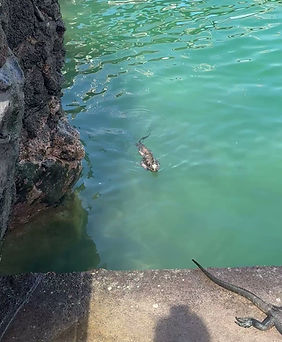
Lava Lizard
Crabs

Hermit Crab


Sally Lightfoot Crab


Sea Lions

Fowl

Pelican at fishing wharf

Frigate Bird

Night Heron

Waiting for handouts

Blue-footed and Nasca Boobies

Galapagos Dove

Darwin Finch

Yellow Warbler

Mockingbird

Mockingbird with snake
Giant Tortoises


Giant Tortoise giant poop
Sea Turtles


Quito
In modern times Quito functions as the capital and administrative center of the country of Ecuador, but there is archaeological evidence of established settlements inhabiting the area between 4400 and 1600 BC. In the late fifteenth century, the region's original inhabitants, the Quitu people, were defeated and replaced by the Incas who made it the center of the Incan empire's northern region. But this was short lived because in the following century the city was conquered by the Spanish - officially founding it as a city.
Quito is the oldest capital city in South America and the second highest in elevation in the world, at over 9,000'. You will be thinking "Aha, it must be in the Andes mountains" and you would be correct. This growing city lies in a valley surrounded by steeply sloping green mountains and attempts to climb up the slopes as the population increases.
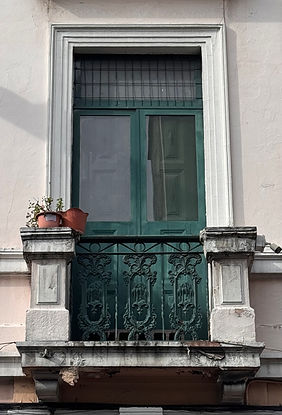
The colonial heart of the city, the Old Town, is one of the most beautifully preserved and claims UNESCO World Heritage status since 1978. Unfortunately many of the historic buildings in the Old Town are vacant and crumbling. Nevertheless it is a major tourist spot and is usually swarming with visitors from all over the world who are accommodated with many museums, restaurants with excellent food, and shopping opportunities.


Old Town


Casa del Albado
(Museum of pre-Columbian artifacts)


Doors and Windows




Equator Line
At the globe's bulging waistline, things get bizarre. The sun, for one thing, is either in the southern sky (in winter) or the northern sky (in summer), so if you happen to be using a sundial to tell the time, it must be vertical and have 2 sides. For another thing, a person is further from the center of the earth (due to that bulge, yo) and therefore weighs about .5% less than at the north pole, so dieting may not be such an imperative... Truth is, the centrifugal force from Earth's rotation, which is highest at the equator, and the fact that the Earth's bulge puts you further from the center of gravity really does have a very minor effect on weight.
What is not a true fact, no matter what they tell you at the Equator Museum, is the notion that water in your sink or toilet drains clockwise north of the equator and counterclockwise south of the equator. Nevertheless people like to believe that absurdity so they demonstrate it for you.


Left foot in northern hemisphere, right foot in southern hemisphere


Ecuador is home to over 130 species of hummingbirds!

Cotopaxi Volcano
One of the highest volcanoes in the world can be found just an hour drive from Quito. Only the second highest peak in the country (the highest being Chimborazo), Cotopaxi is nevertheless way up there in the clouds at 19,347 ft (5,897 m). AND it's an active volcano with the latest eruption occurring just a few years ago (October 2022).
For a very affordable price you can get yourself on a day trip to the national park that will bring you through the cool, high altitude "paramo" environment with vast vistas in the rarified heights, and other interesting stops along the way. They will feed you coca tea to help with the altitude (and attitude!). We drove up to a parking lot at over 15,000 and then climbed up to the "base camp" at 15,800ish ft. I'm in pretty good physical shape but that was a challenge! On this hike, your guide will assure you that the volcano's behavior that signals an upcoming eruption HAVE DEFINITELY NOT BEEN DETECTED LATELY!


